

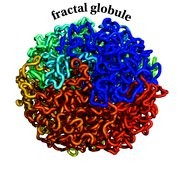
Fractal globule model Lieberman-Aiden’s new technique for creating 3-D genomic maps (Hi-C), gave him evidence him to theorize that the structure of the human genome forms a “fractal globule.” Here the genome forms super-dense, knot-free “globules of globules of globules,” which allows for regions in 1-D to also occur nearby in 3-D. Nearby regions are indicated using similar colors. |
Elise Hens
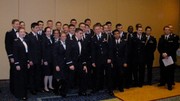
Members of ROTC are pictured at the Joint Forces ROTC Ball on Friday. The event brought together MIT students from all four of the ROTC military services as well as other students from schools without ROTC programs. |
Lemelson-Mit Program
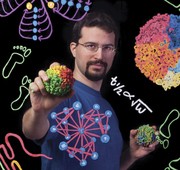
Erez Lieberman-Aiden G invented a way to find out how the genome folds. |

Lenoid A. Mirny and Erez Lieberman-Aiden
Peano curves Discovered by Giuseppe Peano in 1890, Peano curves are a class of one-dimensional space-filling curves that densely fill higher dimensional space. Liberman-Aiden, winner of the Lemelson-MIT Student Prize, recently published a 3-D map of the genome that suggests long stretches of DNA fold into Peano-curve–like structures. |
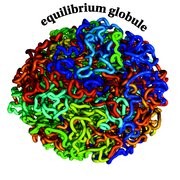
Equilibrium globule model The “equilibrium globule” is an older model that describes how the genome might exist in three-dimensions. Unlike in the “fractal globule” model, here individual strands are highly entangled and regions nearby along the chain are far apart in 3-D. In this image, nearby regions on a chain of DNA are indicated using similar colors. |

Courtesy of the MIT Energy Conference
At the MIT Energy Conference on Saturday, United States Senator Jeff Bingaman (D-NM) speaks about the steps that the U.S. must take to achieve energy independence. The annual student-run conference focuses on technology- and policy-based solutions to global energy problems. |

WCVB-TV
Geoffrey V. Wilson ’02, current Media Lab employee, has been charged with the first-degree murder of his six-month-old son. Wilson, 31, is an MIT alumnus and an administrator at the Media Lab. |

Greg SteinBrecher—The Tech
The candidates for UA president and vice president participate in a debate in the student center on Sunday. Electronic voting will begin next Tuesday and end next Thursday; paper balloting will occur next Friday. For a video of the full debate, see http://tech.mit.edu/V130/N11/uadebate/video.html |

Peter H. Rigano
John Paul Pitts, vocalist and guitarist for Surfer Blood, performs in Rhode Island on Wednesday. Surfer Blood is a indie and pop band from West Palm Beach, Florida. |

David Chen—The Tech
Hillary E. Jenny ’12 gets ready for a forehand during the women’s tennis match in the J.B. Carr Tennis Bubble on Saturday morning. The Engineers lost 8-1 against New York University. |

Meng Heng Touch—The Tech
Andy Tsao ’13 competes in the final round of the 3x3 Rubik’s Cube competition in the student center on Saturday. Patricia Li ’13 averaged the second fastest time ever by a female competitor in the 3x3 competition. |

|

 View Archives